Custom Perfume Cost Breakdown: Budgeting a Signature Scent for Hotels and Spas
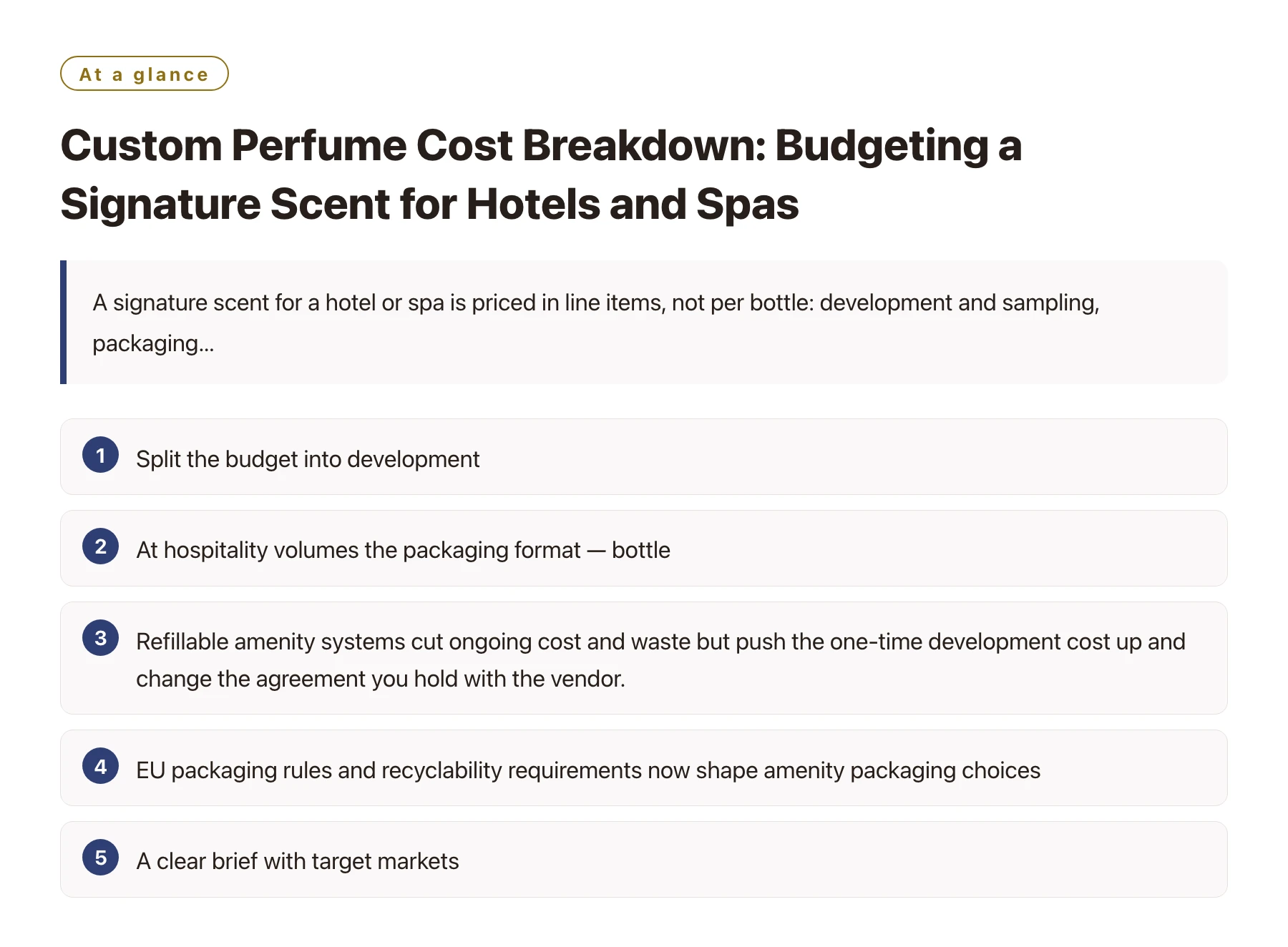
A signature scent for a hotel or spa is priced in line items, not per bottle: development and sampling, packaging format, filling and quality control, compliance and logistics. At the volumes hospitality typically needs, packaging usually dominates the unit cost, so the fastest way to change the budget is to change the pack, not the formula. Plan the cost structure before you brief a supplier, and the negotiation becomes a list of trade-offs instead of a single number.
Key takeaways
- Split the budget into development, packaging, filling and QC, and compliance; most hospitality projects misjudge the first and underestimate the last two.
- At hospitality volumes the packaging format — bottle, pump, refillable dispenser or sachet — usually decides the unit cost more than the juice does.
- Refillable amenity systems cut ongoing cost and waste but push the one-time development cost up and change the agreement you hold with the vendor.
- EU packaging rules and recyclability requirements now shape amenity packaging choices, so check the destination markets before locking the pack.
- A clear brief with target markets, volume and package format lets you compare quotes line by line rather than bottle to bottle.
The first question most hotel and spa buyers ask a perfume supplier is how much a bottle costs. It is the wrong first question, because the answer depends on decisions that have not been made: whether a scent is developed for the brief or chosen from an existing line, which bottle or dispenser system the amenity uses, how many units flow through the property each year, and which markets the packaging must satisfy.
When the numbers finally arrive, they rarely arrive as one line. A serious quotation separates development from packaging from filling from compliance, and that separation is what makes the budget negotiable.
This article walks through the cost structure of a hospitality fragrance project, the levers that actually move the total, and the sequence that keeps quotes comparable.
Where the money actually goes
Development and sampling
This is the one-time work: interpreting the brief, building or selecting the scent, running sample rounds and fixing the approval reference. It is a fixed cost, so it feels large on the first order and becomes smaller relative to the total as volume grows. Compare development fees as a line, and be clear about how many sample rounds the fee covers.
Packaging format
At the volumes a single property consumes, the pack — bottle, pump, closure, label, carton or the dispenser system bolted to the wall — usually outweighs the liquid in the unit price. A lobby diffuser, a 40 ml amenity bottle and a refillable dispenser are different products with different cost structures, and choosing the format early stops the quote from drifting.
Filling, QC and stability
Filling runs carry labour, line setup and quality control per batch, and a new product needs stability and compatibility work before release. These costs do not scale down with small runs, which is one reason tiny orders look expensive per unit.
Compliance and logistics
The finished product needs safety documentation, labels that match each market, and — for hospitality especially — the paperwork that lets a hotel group buy the same product across several countries without re-qualifying it. Freight for heavy amenity packs is a real line too, and it is the one buyers most often forget.
The cost lines, the drivers, the controls
| Cost line | What drives it | How to control it |
|---|---|---|
| Development and sampling | Brief complexity, sample rounds, exclusivity | Fix the round count in the fee, and the exclusivity in the contract |
| Packaging | Bottle, pump, closure, label, carton, dispenser | Choose the format early; compare packs as separate lines |
| Filling and QC | Batch size, filling method, tests, stability | Batch several months of demand into fewer runs |
| Compliance | Markets, safety documents, label versions | Fix the market list before the formula is approved |
| Logistics | Freight, duty, warehousing of amenity packs | Consolidate shipments; negotiate freight on the annual volume |
The rows are not equally heavy for every project. For a spa retail bottle the packaging line dominates; for a refillable dispenser program the development and installation costs dominate. Name the format first and the comparison works.
The packaging lever
Hospitality fragrance is unusual because the pack is both a product and a piece of the room design. That makes the packaging decision a brand decision, but it is still the biggest cost lever. Recyclability and material choice are now standard considerations, pushed by organisations that promote sustainable packaging design [2], and in the EU the packaging placed on the market — including amenity packs in hotel rooms — must meet the packaging requirements the bloc applies to member states [1].
The practical effect: a refillable dispenser lowers the per-refill cost and the waste volume, but it shifts money into the hardware and the refill logistics; a one-way bottle is simpler to source but repeats the packaging cost on every unit. Neither is cheaper in the abstract — the property's volume and the guest experience decide which one wins.
Refillable versus one-way
Refillable systems also change the relationship with the vendor: the property buys the refill, and the bottle life, refill fit and hygiene become part of the quality agreement. If the wall-mounted hardware is a single-vendor product, price pressure shifts to the refill — budget the hardware and the refill as separate commitments, not as one purchase.
A budget sequence that works
- Fix the product lineLobby scent, room amenities and spa retail are different packs with different budgets; name each one.
- Fix the volumesUnits per year and per location decide whether custom development is worth its one-time cost.
- Fix the pack before the quoteBottle, pump, refillable dispenser or sachet — the format moves the unit price more than the juice does.
- Demand separate linesDevelopment, packaging, filling and compliance quoted separately, so every line can be challenged.
- Add the forgotten linesSample kits, stability work, test shipments, label revisions and freight belong in the budget.
- Re-cost at scale-upA pack that wins at 500 units a year can lose at 5,000; re-run the comparison before the second season.
Choosing and negotiating the partner
For the scent itself, a custom fragrance development partner that runs development, packaging and filling as one project makes the budget easier to hold, because the line items live in one document instead of three invoices with different currencies.
Many hotel brands de-risk the first season with an existing scent and move to a custom development later — starting with Xuelei to validate the concept, then commissioning a bespoke scent once the volumes justify the one-time cost. The switch works when the ownership and exclusivity terms were written down at the start.
Before asking for a quote, check whether the candidate really covers development, packaging and filling under one roof. A manufacturer's own site usually says — Xuelei's website, for example, presents the full service scope publicly, so the question is answerable before the first call rather than after the contract.
Sources
- European Commission: Packaging Waste and the PPWR —— EU rules on packaging and packaging waste, including the Packaging and Packaging Waste Regulation requirements on recyclability and design.
- Sustainable Packaging Coalition —— A membership organisation working on more sustainable packaging design, publishing material and recyclability guidance.
Frequently asked questions
What is the biggest cost item in a hotel fragrance project?
At typical hospitality volumes it is the packaging format; development is a one-time line that shrinks relative to the total as volume grows. Name the pack early and the rest of the budget falls into place.
How much should I budget for development?
There is no universal figure — it depends on the brief, the sample rounds and exclusivity. Ask for it as a separate line, compare it, and weight it against the volumes the development will be amortised over.
Are refillable dispensers cheaper than bottles?
They lower the ongoing per-refill cost but raise the upfront hardware and logistics cost. The breakeven depends on your volume per location, so run the two packs side by side on your own numbers.
Do EU packaging rules apply to hotel amenities?
Yes — packaging placed on the market in the EU must meet the applicable packaging requirements. Confirm the destination markets and ask the supplier for the packaging documentation before locking the format.
Can I start with an existing scent and go custom later?
Yes, and it is a common path for hospitality brands. Keep the ownership and exclusivity terms written down at the start, so the later switch upgrades the scent instead of rebuilding the project.